
Risk-Reward Ratio for Gold Traders
You won 7 trades out of 10, yet your account is down. How? The winners were tiny and the losers were big. You closed gains quickly out of fear of losing them, and let losses grow hoping price would come back.
This problem has a name: a poor risk-reward ratio. Understanding it changes the way you think about trading.
What Is the Risk-Reward Ratio?
It compares what you risk with what you aim to gain on a single trade.
- Risking $5 on the gold price for a $10 target = a 1:2 ratio.
- Risking $10 for a $5 target = a 2:1 ratio, meaning you risk twice what you aim to gain.
How the Ratio Relates to Win Rate
This table shows the minimum win rate you need to break even (before costs):
| Risk-reward ratio | Win rate needed to break even |
|---|---|
| 1 : 1 | 50% |
| 1 : 2 | 33% |
| 1 : 3 | 25% |
| 2 : 1 | 67% |
At 1:2, winning about one trade in three is enough to break even, and anything above that is a gain. But be careful: a far target is harder to reach, so this is a balance, not magic.
How to Set a Logical Target
Don't pick a random number to improve the ratio. Place the target where price is likely to go:
- The opposite liquidity: the next clear high or low, as explained in liquidity in gold trading.
- A support or resistance zone on the higher timeframe.
- An unfilled gap in the direction of the trade.
Then calculate the ratio. If it is below, say, 1:1.5, the trade may not be worth it.
The Stop Decides Everything
The ratio starts with the stop. A very tight stop gives a nice ratio on paper but gets hit often. A deliberate stop beyond liquidity may lower the ratio, but it is more realistic. Remember that a stop order becomes a market order when reached and may fill at a worse price in fast moves (Investor.gov). Learn the order types in detail in order types in gold trading.
✅ Open a live gold trading account with our partner Traze, a licensed global broker, and get the GoldX Club books and courses as a gift.
Why Do Traders Close Gains Early?
People tend to lock in gains quickly for fear of losing them, and to delay admitting a loss in the hope that price returns. UC Berkeley research shows that individual investors are affected by behavioral patterns that hurt their results, such as overconfidence and overtrading (UC Berkeley).
The fix: set your target and stop before entering, and don't change them emotionally during the trade.
A Practical Gold Trading Example
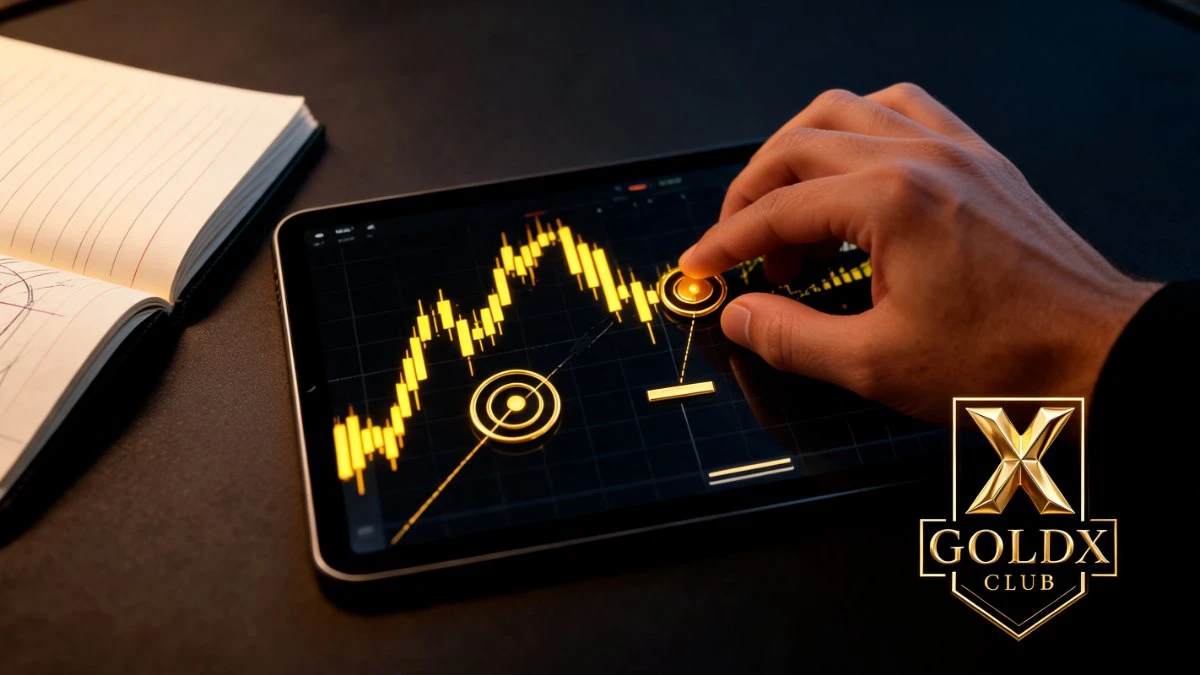
Gold is at 4,150 after taking liquidity below the 4,146 low. The stop goes below the lowest point at 4,145, a $5 distance. The next clear high is at 4,160, a $10 target. The ratio is 1:2. With a $5,000 account and 1% risk, the size is 0.10 lots, as in gold lot size.
Common Mistakes
- Setting a very far target just to improve the ratio.
- Moving the stop further when price gets close to it.
- Closing a gain early with no reason in the plan.
- Ignoring the spread when calculating the ratio.
The Fix: Think in a Series of Trades, Not One Trade
A single trade can lose however good it is. But a series of trades with a good risk-reward ratio and fixed rules is what creates the result. Apply this within smart money concepts to choose logical targets, and learn to read candlesticks to confirm entries.
This article gives you the idea. The full strategies we apply to gold, with clear entry and exit rules, many examples and practical exercises, are in our books Gold Trading for Beginners and The Pro Gold Trading Encyclopedia on the GoldX Club home page. Want to start for free? Download XAUUSD Liquidity Map.
When you are ready to apply this on a live account, start small with a trusted broker:
✅ Prefer another broker? Open your account with XM, a globally regulated broker, and check the offers available when you register.
Summary
- The ratio compares what you risk with what you target.
- At 1:2, a win rate below half can be enough.
- Place the target at liquidity or a clear zone, not a random number.
- Set the stop and target before entering and don't change them emotionally.
- Think in a series of trades, not one trade.
FAQ
◆ What is the best risk-reward ratio?
There is no perfect ratio for everyone, but many traders prefer 1:2 or more, as long as the target is logical and reachable.
◆ How do I calculate the risk-reward ratio?
Divide the distance from entry to target by the distance from entry to stop. For example, a $10 target and a $5 stop means 1:2.
◆ Can a 40% win rate work?
Yes, if your average gain is about twice your average loss, after accounting for costs.
◆ Should I move my stop to breakeven?
Some traders do once price moves in their favor, but it should be part of your written plan, not an emotional decision.
◆ Why do I lose even though most of my trades win?
Because your losses are usually bigger than your gains, from closing winners early and letting losers grow.
This content is for education only and is not investment advice. Trading financial markets carries a high level of risk, and you may lose some or all of your capital.
Disclaimer and Risk Warning: This website and everything it offers is educational content only. It is not investment advice or a recommendation to buy or sell, and GoldX Club and its team accept no responsibility for any losses or damages, direct or indirect, or for decisions you make based on any content we provide, in any form or through any channel. GoldX Club is an independent educational platform; it is not a broker and does not receive or manage client funds. Trading and investing in financial markets carries a high level of risk and may result in the loss of some or all of the capital invested. Prices of assets, currencies and gold are subject to rapid volatility and may not be suitable for all investors. You should assess your own knowledge, experience and investment objectives, and never risk money you cannot afford to lose. Links to our approved partners on this site are partner links, and we may receive a commission from the broker when a client registers through them, at no extra cost to the client. Clients who register through our links may receive exclusive benefits, competitive spreads, dedicated support and bonuses where the broker's rules and the client's country allow, subject to each broker's terms.
© 2026 GoldX Club. All rights reserved.