
Why Gold Hits Your Stop Loss and Then Reverses
You enter a gold trade after careful analysis and place your stop loss below the low, just as you were taught. Price drifts toward it… touches it by a few points… your trade closes at a loss, and then price takes off exactly in the direction you expected.
If this keeps happening to you, you are not alone, and it is not bad luck. This move has a name and a reason, and understanding it is the first step to stop repeating it. Gold moves toward liquidity, and that is what this guide explains.
The Problem Is Not Your Analysis, It Is Where Your Stop Sits
Most traders learn the same rule: "Place your stop below the last low on a buy, and above the last high on a sell." The rule makes sense, but when thousands of traders apply it at the same spot, that spot becomes an exposed point on the chart.
A large number of stop-loss orders gather below obvious lows and above obvious highs. And every stop order is really a buy or sell order waiting to be filled. That is where the story begins.
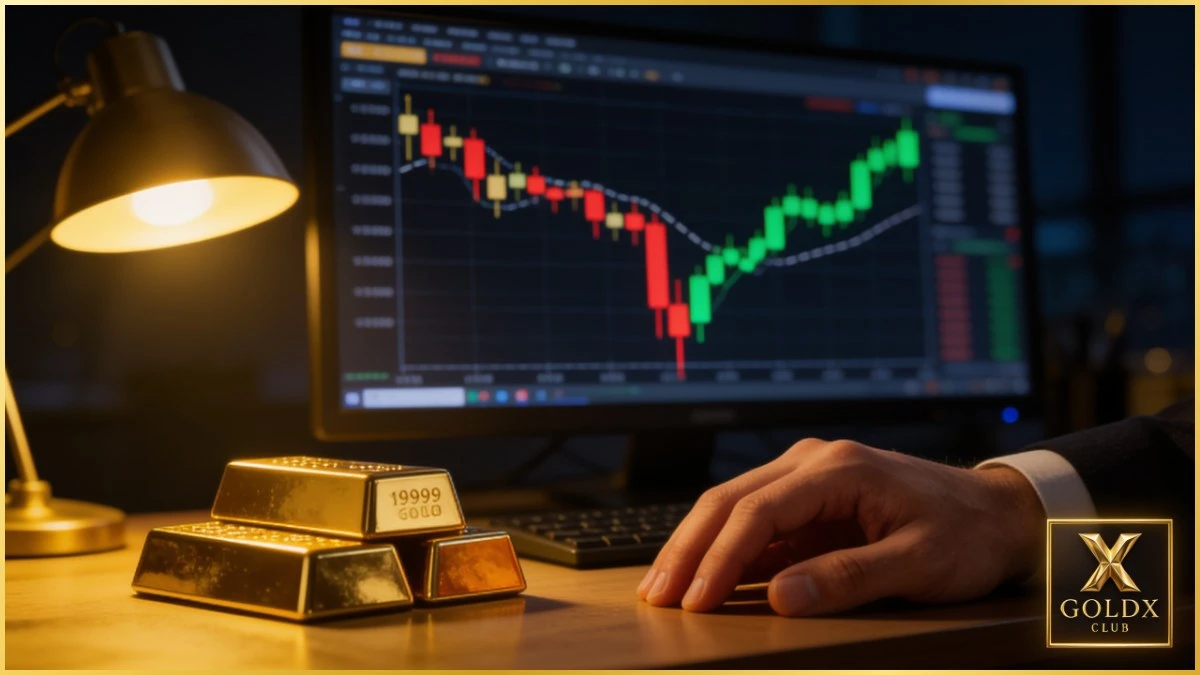
What Is Liquidity and Why Does It Attract Price?
Liquidity is simply the orders waiting in a certain area of the chart. Every trade needs a counterparty: whoever wants to buy a large amount needs someone to sell to them, and whoever wants to sell needs a buyer.
Large financial institutions cannot fill huge positions at any random price. They need areas with enough orders to fill their size without pushing price too far against them. Where are those orders concentrated? In the stop orders stacked below lows and above highs.
Gold is one of the largest and most liquid markets in the world, trading around the clock through major hubs such as London, New York and Shanghai (World Gold Council). That size makes liquidity zones on the XAUUSD chart clear and powerful.
How a Stop Hunt Happens, Step by Step
It can be simplified into four stages:
- Accumulation: price moves in a tight range and prints close or equal lows. Traders see "strong support" and place their stops below it.
- The trap forms: the longer the range lasts, the more stop orders build up below the low, and the more obvious the target becomes.
- The false break: price drops quickly below the low and the stops trigger all at once. Those orders give large buyers the volume they need at a better price.
- The reversal: once the liquidity is absorbed, price returns strongly above the low and often runs in the original direction, while the traders with stops are already out.
Watch for this sequence on the gold chart: equal lows, the stop-order zone below them, a fast break, then the reversal.
Why Does This Happen So Often in Gold?
- High volatility: gold is known for fast moves, especially during US economic news, so it can reach liquidity zones within minutes.
- Levels that are too obvious: everyone sees the highs and lows on the gold chart and places stops there.
- Session overlaps: when London and then New York open, volume jumps suddenly, and false breaks often happen at these times. We cover this in detail in the best time to trade gold.
Where Should You Place Your Stop Loss in Gold?
There is no completely "safe" spot, because trading stays high risk. But some principles reduce the chance that you become part of the liquidity being hunted:
- Avoid the obvious spot: if everyone places their stop right below the low, that is the area most likely to be broken. Think about where your analysis is actually wrong, not where others put their stops.
- Tie the stop to structure, not to a number: instead of "20 points below entry", ask: which level, if broken, means the trade idea is over?
- Wait for the sweep instead of being its victim: some traders wait until the liquidity grab happens and price returns above the low, then look for an entry after the reversal.
- Adjust position size, not stop placement: if the logical stop needs more distance, reduce the position size so the risk stays within your limits, instead of moving the stop into an exposed area.
- Be careful around news: violent news moves can blow through any nearby stop in seconds.
Remember that your stop is executed by your broker. Execution quality and a low spread at the London and New York opens decide how much you actually lose when the stop is hit. That is why it pays to choose a licensed broker with accurate execution.
✅ Open a live gold trading account with our partner Traze, a licensed global broker, and get the GoldX Club books and courses as a gift.
Common Mistakes That Make Your Stop an Easy Target
- Placing the stop exactly on a round number such as 2000 or 2050.
- Moving the stop closer after entry out of fear.
- Entering in the middle of a range, then placing the stop below the obvious low.
- Relying on indicators alone without looking at where orders gather.
The Fix: Read Liquidity Before You Enter
The difference between a trader whose stop keeps getting hunted and a trader who reads the move is not the number of indicators. It is one question asked before every trade: where is liquidity sitting, and who will benefit from it?
Once you see the chart this way, equal lows turn from "strong support" into "a possible trap", and a sudden break turns from a shock into a chance to understand what is happening.
After price takes the liquidity, it often launches from an area where institutions left their footprint, which we explain in order blocks in gold.
This article gives you the idea. The full strategies we apply to gold, with clear entry and exit rules, many examples and practical exercises, are in our books Gold Trading for Beginners and The Pro Gold Trading Encyclopedia on the GoldX Club home page. Want to start for free? Download XAUUSD Liquidity Map.
When you are ready to apply this on a live account, start small with a trusted broker:
✅ Prefer another broker? Open your account with XM, a globally regulated broker, and check the offers available when you register.
Summary
- A stop hit followed by a reversal is not a coincidence. It is usually a liquidity grab at obvious levels.
- Large institutions need enough orders to fill their positions, and stacked stop orders are a source of those orders.
- Equal highs and lows in gold are often traps, not guaranteed support and resistance.
- Place your stop where your trade idea ends, not where everyone else places it, and control risk through position size.
- Trading is high risk: the European Securities and Markets Authority reports that between 74% and 89% of retail CFD accounts lose money (ESMA). Understanding and risk management come before any trade.
FAQ
◆ Why does the market hit my stop loss and then reverse?
Because stop orders gather at obvious levels, and markets move toward these areas to absorb the liquidity there before continuing. This move is called a liquidity grab or stop hunt.
◆ Does a stop hunt mean my broker is manipulating my trade?
Not necessarily. Liquidity grabs are normal market behavior caused by orders clustering at the same levels. Still, always use a broker licensed by a known regulator.
◆ Where should I place my stop loss when trading gold?
At the level where a break means your trade idea is wrong, away from the obvious spots where everyone places stops, with position size adjusted so the risk stays within your limits.
◆ Should I trade without a stop loss to avoid being hunted?
No. Trading without a stop loss puts your whole capital at risk. The answer is a well-placed stop, not no stop.
◆ How do I learn to read liquidity in gold?
Start by marking equal highs and lows and tight ranges on the XAUUSD chart, and watch what happens there. The free XAUUSD Liquidity Map guide explains these steps in detail with examples.
This content is for education only and is not investment advice. Trading financial markets carries a high level of risk, and you may lose some or all of your capital.
Disclaimer and Risk Warning: This website and everything it offers is educational content only. It is not investment advice or a recommendation to buy or sell, and GoldX Club and its team accept no responsibility for any losses or damages, direct or indirect, or for decisions you make based on any content we provide, in any form or through any channel. GoldX Club is an independent educational platform; it is not a broker and does not receive or manage client funds. Trading and investing in financial markets carries a high level of risk and may result in the loss of some or all of the capital invested. Prices of assets, currencies and gold are subject to rapid volatility and may not be suitable for all investors. You should assess your own knowledge, experience and investment objectives, and never risk money you cannot afford to lose. Links to our approved partners on this site are partner links, and we may receive a commission from the broker when a client registers through them, at no extra cost to the client. Clients who register through our links may receive exclusive benefits, competitive spreads, dedicated support and bonuses where the broker's rules and the client's country allow, subject to each broker's terms.
© 2026 GoldX Club. All rights reserved.